You don’t need to do all seven things this weekend. But this passive income playbook is a start.
Welcome, Equity Mate.
If you’ve just scanned the QR code at my FinFest presentation, you’re in the right place. This is the passive income playbook: seven steps to turn the money you earn today into more freedom tomorrow.
I think about it like building a snowball.
First, you find the snow. You pack it together, carry it uphill and give it a push. Then you keep it on course until, eventually, it gathers more snow than you could add by hand.
The image has a famous investing connection: Alice Schroeder called her biography of Warren Buffett The Snowball. It’s a useful way to think about a lifetime of accumulating assets.
If you’re pursuing financial independence and early retirement — FIRE — this journey might take a decade. Or it might take most of your working life. Your income, starting position, spending and investment results all matter. Ten years is a possibility, not a deadline for your plan. (Our FIRE course is free, FYI.)
And these steps overlap. You don’t need to finish learning before you start investing, or own a home before you can build a portfolio.
The aim is to gradually make your lifestyle less dependent on turning up to work.
Your passive income playbookStep | Strategies | Tools |
|---|---|---|
1. Find the snow | Build earning power through your career, a business or a purposeful side hustle. | Do research on Seek or Indeed, follow people on LinkedIn. Use Rask's Career profiles; free TAFE skills training; The Australian Business Podcast 10-part series. |
2. Compact it | Keep more of what you earn. Build a repeatable savings habit and clear expensive consumer debt. | Bank statements, Pocketsmith for the adventrous; Rask's cashflow analyser; using separate accounts and automatic transfers. |
3. Go up the hill | Do the early work. Decide what matters, set priorities and give your money a purpose. | Create a vision board with your partner; keep a simple written plan; a regular money conversation. |
4. Start pushing | Begin accumulating productive assets. Consider a suitable home, diversified ETFs and super. | First-home buyer schemes; a mortgage broker; an investment account; Rask education. |
5. Keep it on track | Invest regularly, prepare for family changes and review debt, insurance and contributions. | Investment automation; an emergency fund; a cash-flow plan; financial and tax advice. |
6. Watch it roll | Let compounding do more of the work. Plan the move from earning and saving to spending. | Retirement projections; a spending plan; portfolio and super reviews. |
7. Enjoy it | Draw on your assets sustainably and use the freedom you’ve created. | A diversified retirement portfolio; a withdrawal plan; estate planning; regular check-ins. |
Before you debate which ETF to buy, you need something to invest.
That usually means earning an income.
“Do what you love” is incomplete career advice. I’d rather you find work you enjoy, can become good at, and that people will pay you properly to do.
Those things don’t always arrive together. Sometimes you develop the valuable skill first and enjoy the work more as you gain competence and control.
If you’re a tradie, dentist or other professional, building a business might be part of your answer. But being self-employed and owning a business that runs without you are different things.
Robert Kiyosaki’s cash-flow quadrants give us a useful vocabulary: employee, self-employed, business owner and investor. You can earn through more than one, and you don’t have to quit a good job to become an investor.
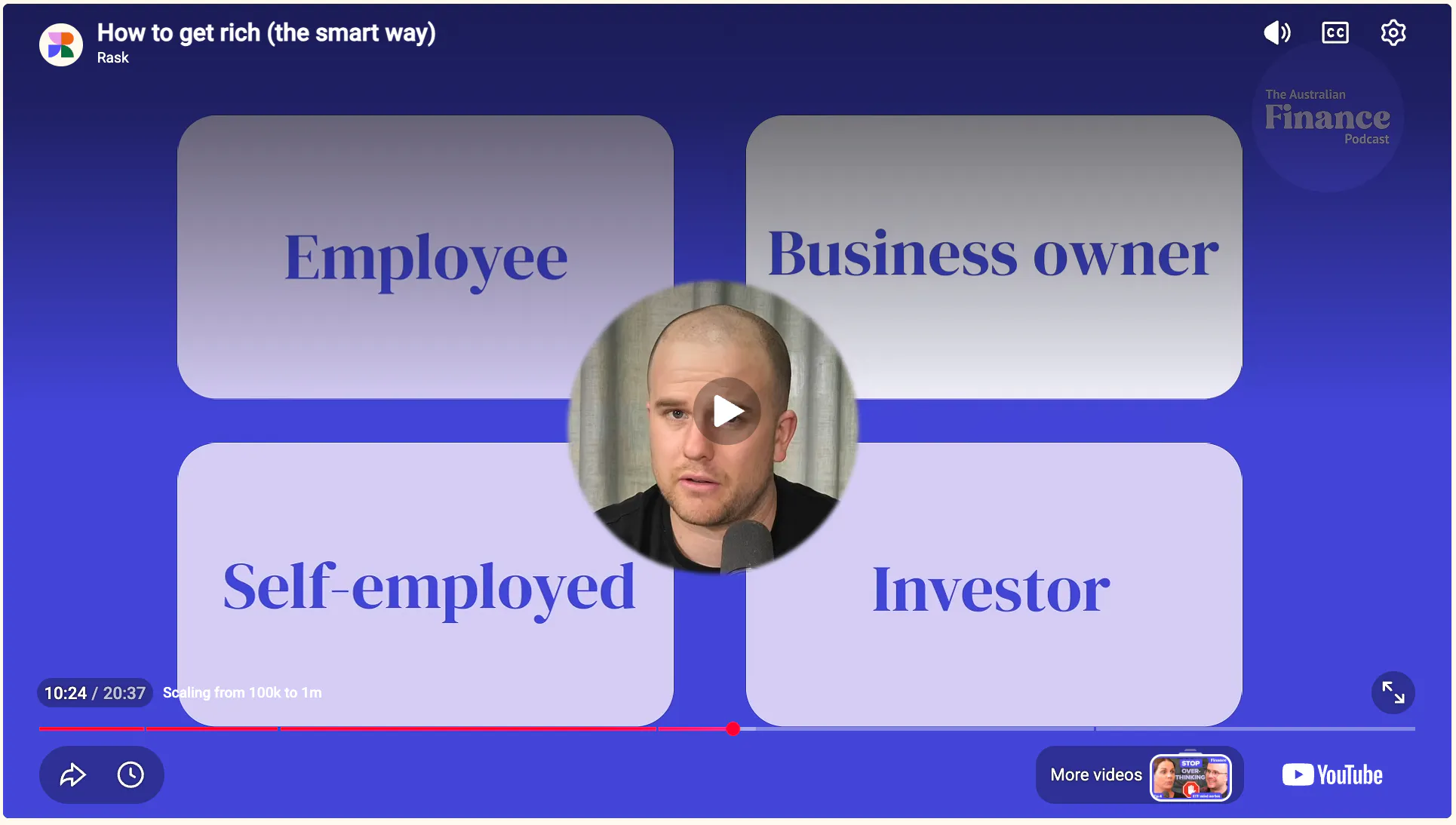
Ask yourself: if I stop working for a month, which income stops with me?
That question can reveal whether you own a system or have simply bought yourself a demanding job.
Side hustles can help too. My preference is to give them a purpose and a review date: build the deposit, clear the credit card, seed the portfolio.
The trap is allowing your lifestyle to grow until it needs your salary and your Saturday income. You’ve worked harder but become less free.
Your next move: identify one realistic way to improve your earning power. It could be a qualification, a pay conversation, a better role, improved business pricing or a short-term project.
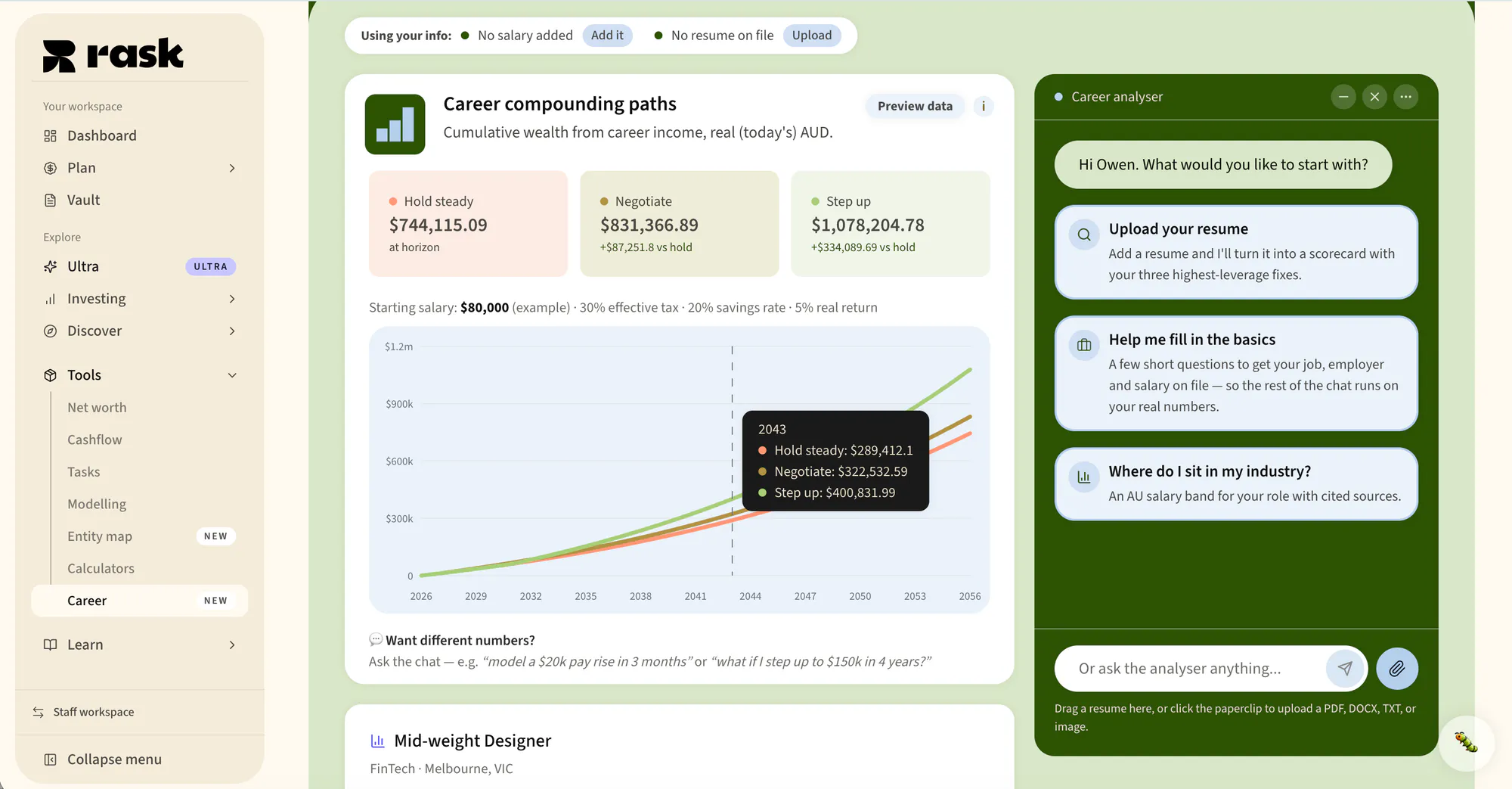
Useful tool: Jobs and Skills Australia’s has occupation profiles to help you investigate earnings, employment and career options. The Rask Career Analyser tool is still in Beta but better - it lets you drop in your resume and income, then plots your income potential with actionable career tips.
 2. Compact it
A good income gives you snow. Saving turns it into something you can work with.
During a recent YouTube live session, people told me they were saving anywhere from 15% to 60% of their income. That’s a self-selected group, not a national benchmark. But it shows how differently households can organise their lives.
Your savings rate will change with your circumstances. A couple without children and a parent paying for childcare are playing different games.
For a simple measure:
Cash savings rate = money set aside for saving and investing ÷ take-home income × 100.
If $8,000 comes into your household each month and you set aside $2,000, that’s $2,000 ÷ $8,000 × 100 = 25%. Keep employer super out of both sides of this particular calculation.
Start with your own number. Then work out what would improve it.
That might mean earning more. It might mean moving house, reviewing recurring expenses or paying off expensive consumer debt. It probably won’t be solved entirely by feeling guilty about coffee.
Morgan Housel’s The Psychology of Money makes a point I return to often: doing well with money is not about how smart you are, but how you behave.
I sometimes think money management has more in common with good design than advanced maths. You’re designing your week, your routines and your surroundings so the right choices become easier.
That’s where mindfulness helps me: noticing what I’m buying, why I’m buying it and whether I actually enjoy it. My old cohost on The Australian Finance Podcast, Kate Campbell, popularised the 10 Things Activity.
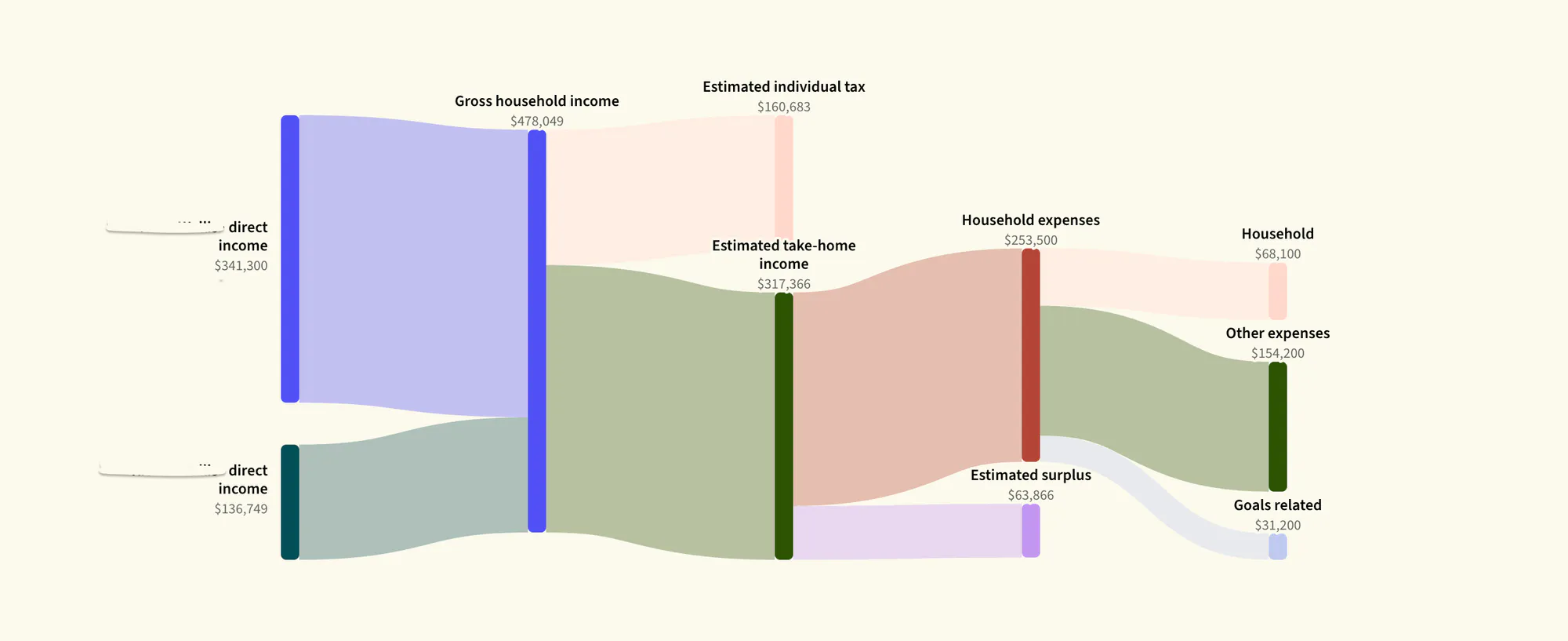
Your next move: review three months of spending, choose a sustainable savings amount and automate it after payday. Include irregular bills so your “savings” aren’t simply next month’s car insurance.
Useful tool: Moneysmart’s budget planner. A basic plan you use beats an elaborate spreadsheet you avoid.
3. Go up the hillThis is your biggest effort.
You might put in a harder year or two, or you might need longer. You’re building savings, improving your earning power and making decisions whose benefits may still feel a long way off.
It helps to know what you’re doing it for.
People often describe budgeting as sacrifice. That hurts more. And like a restrictive budget, isn't sustainable and therefore won't change your life (for the better, anyway). I prefer to think about budgeting as "rearranging priorities".
If travelling matters more than a newer car, your budget should reflect that. If working four days a week matters more than a bigger house, put it in the plan.
Otherwise, you can spend decades financing things you never consciously chose.
This is why I like a vision board.
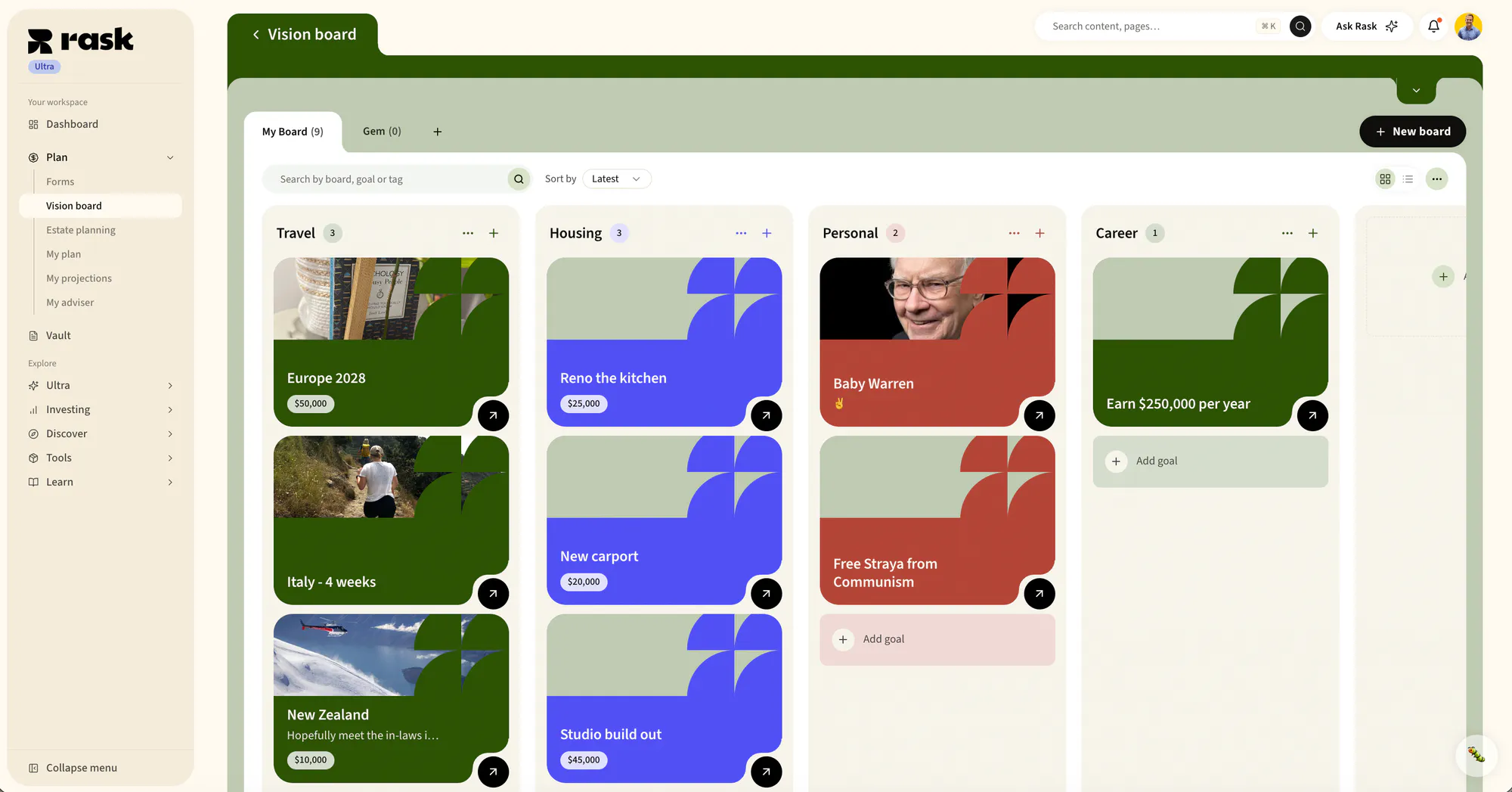
The Rask vision board activity asks you to think beyond an account balance. What do you want your life to look like? Who is in it? How do you spend a normal Tuesday?
Gemma talks about goals such as becoming healthier and wealthier. I like thinking in decades: family in my 30s, the possibility of a four-day working week in my 40s, more freedom to retire early in my 50s.
These are directions, not contractual obligations to your younger self.
The board also needs actions underneath it. Research by psychologist Gabriele Oettingen and colleagues distinguishes positive expectations from positive fantasies: imagining a wonderful future isn’t the same as doing the work to reach it.
So next to “work less”, write the obstacle and your next practical step.
I think of this as avoiding the wrong-mountain problem. You climb towards money, status or a bigger business, reach the top, then realise you wanted more time with your family.
Try to choose the mountain before you spend 20 years climbing it.
Your next move: use our vision board tool. Or grab on a piece of paper and divide it into 3 columns: what you spend the most money on, another for your time, and the final one for what brings you joy. Notice any patterns?
 4. Start pushing
Now you’re building the assets that can eventually support you.
Think about three parts of your plan together: a home, investments outside super and superannuation.
They do different jobs. Your home provides somewhere to live; it doesn’t automatically pay you an income. Your outside-super investments give you flexibility. Super helps fund later life.
A home that fits your plan
If I were starting again, I’d use the First Home Super Saver scheme and the Australian Government 5% Deposit Scheme.
The FHSS scheme lets eligible buyers use voluntary super contributions towards a first home. Up to $15,000 of contributions per financial year can count, within a $50,000 overall contribution limit - per person. The amount released depends on contribution type, tax and associated earnings. Importantly, your rate of return and what you can draw out of the Super fund is not set by your fund's performance but by the ATO's Shortfall Interest Charge (SIC) - over 7% right now. It changes quarterly, but try getting that in a bank account - after tax!
Obviously, check the ATO process before committing to a purchase because it's complex. Our friends at Pearler have plenty of information on the FHSS, and a calculator.
Labor's 5% Deposit Scheme / 95% loan scheme can help eligible buyers purchase a home without lenders mortgage insurance (LMI), subject to property caps and lending criteria. It is a guarantee to the lender, not a cash gift or a discount on the mortgage. So you end up with a 95% mortgage and still need to cover stamp duty, etc. (in addition to the 5% deposit).
I like the principle behind “the worst house in the best street”: prioritise lasting appeal over fashionable finishes. But check the building, location, price and ownership costs. A terrible house can still be a terrible purchase.
And consider the commute as part of the trade-off - if you commute a long way to work, it's probably a sign that you chose to prioritise your financial future (by buying a good house) over being an inner city yuppy with a dog box.
A train trip can become reading, study or podcast time. Paying a large premium to avoid it might delay other lifestyle or financial goals. Equally, a commute that wrecks your family life isn’t much of a bargain. All I'm saying it, get some perspective.
Buy a small slice of many businesses
You can also start building a diversified ETF portfolio.
An ETF is a fund traded on an exchange. A broad share-market ETF can hold many businesses in one investment. You still face market risk, but you’re less dependent on one company getting everything right.
Then celebrate your first distribution.
People have asked me to sign their first dividend statements at events. Sometimes the payment is only a few cents or a couple of dollars. I love that.
We take photos outside our first house — often alongside a very large mortgage. We should also celebrate the first time an asset pays us.
The dollar amount is small. The habit matters.
Borrowing can accelerate asset accumulation, but it magnifies losses and adds repayments. It belongs in a plan you can afford through bad periods, not just a spreadsheet showing good ones.
Your next move: choose an achievable first asset-building action while keeping money for near-term expenses accessible.
5. Keep it on trackLife rarely follows the contribution schedule.
Children arrive. Someone changes jobs. A business has a slow quarter. The hot-water system chooses violence.
Your plan needs room for all of it.
Start with a cash buffer. I like to see 6 months of living expenses as a useful emergency-fund target. Sometimes higher if you're a single-income family (if you own a property, use your offset account, not a savings account). Again, if your income varies or you have greater responsibilities, you may want more.
Before parental leave or another major change, map the reduced income and likely costs. Review appropriate life, disability and income-protection cover, along with your will and super beneficiaries.
Keeping a smaller investment contribution going may be worthwhile. Temporarily pausing it to protect the household can also be sensible.
Automate the repeatable parts
Dollar-cost averaging means investing a set amount regularly — for example, $500 each month.
It gives investing a place in the household routine without requiring you to predict next Tuesday’s share prices.
Charles Schwab’s market-timing study compared five hypothetical investors, including a perfect timer, someone investing immediately, a monthly investor and someone waiting in cash. In its 20-year example, investing promptly or regularly finished well ahead of remaining in cash.
The lesson isn’t that timing can never work, or that regular investing prevents losses. It’s that waiting for certainty has a cost. If you already have a lump sum ready for long-term investment, deliberately spreading it out is also a different decision from investing money as you earn it.
Tools such as Pearler’s investing automation can help with the routine. Check fees, available investments and account arrangements before choosing a platform.
Review debt recycling carefully
If you own a home, debt recycling may be worth discussing with your financial adviser and tax adviser.
Broadly, it involves paying down non-deductible home debt and separately borrowing to acquire income-producing investments. It can change the purpose and potential tax treatment of part of your debt.
Simply having equity isn’t debt recycling. Nor does securing a loan against your house make the interest deductible: the use of the borrowed money matters.
Loan structure, records, current tax rules and your ability to carry losses all matter. This is a strategy to get right before moving money.
Pay rises are another opportunity. Decide how much goes towards enjoying life and how much goes towards future freedom before it disappears into ordinary spending.
Your next move: review the plan whenever life changes, with a scheduled check-in at least annually. Adjust the contribution before abandoning the goal. Right now, the economy is cooked - but the habit is more important than the amount you save. You might have saved $2,500 per month without kids, two jobs and in a good economy and now you can only afford $50 per week through a micro investing platform. Keep the habit!
6. Watch it rollEventually, the scale changes.
Early on, your contributions do most of the work. Later, investment returns can become a much bigger part of the picture.
Here’s an illustration, not a forecast.
Annual investment return in dollars = portfolio value × assumed annual return.
At an assumed 6% total return, a $100,000 portfolio would generate $6,000 before fees and tax. A $500,000 portfolio at the same assumed return would generate $30,000.
That includes changes in value as well as income; it isn’t necessarily cash you can spend. Actual returns fluctuate and can be negative.
But it shows why the same percentage starts to feel very different on a larger base. When returns are retained and reinvested, they can earn returns of their own.
You may notice this more in your late 40s, 50s or 60s. Those ages aren’t entry requirements.
Now you can start asking different questions. Could you reduce your hours? Could you change careers? Could you afford a year with more travel and less work?
This is also the time to develop a spending plan.
Ramit Sethi’s approach to conscious spending encourages you to make room for what you value. Dave Gow at Strong Money Australia writes about the trap of continually postponing enjoyment. Both are useful prompts if saving has become automatic but spending feels uncomfortable.
Aussie Firebug makes a related point: financial independence can mean choosing meaningful work, whether paid or unpaid.
Your next move: use Moneysmart’s retirement planner to explore possible outcomes. Test lower returns, higher living costs and different retirement dates before relying on a projection.
7. Enjoy itThis is where the snowball supports the life you wanted.
That still requires a plan. Investments fluctuate, dividends change and retirement can last decades.
Keep flexibility inside and outside super
I like having assets inside and outside Super. Super looks great in a spreadsheet but the Government can't be trusted not to mess with it (that's obvious) and it's the opposite of a FIRE/early retirement financial plan.
If you’re approaching a conventional retirement age of 60, roughly two-thirds of your investment assets inside super and one-third outside might be a useful discussion starter. I’m excluding your family home here.
It isn’t a universal target. If you’re retiring much earlier, you may need substantially more outside super to fund the years before you can access it.
Under current rules, super can generally be accessed from 60 when an applicable condition of release is met, or from 65 regardless of whether you’re working.
Work backwards from your intended retirement age, spending and other income. Super’s tax advantages matter; so does access to your money. Rules can change, which is another reason to preserve flexibility.
For comparisons, I often use Australian Retirement Trust as a starting point for comparision of 10-year returns, insurance (always check insurance before moving funds!), and fees. That doesn’t make it the best fund for everyone. If you’re with Hostplus, AustralianSuper or another fund, compare the actual investment option, fees, insurance and long-term results on a like-for-like basis.
Platforms such as Netwealth offer a different range of investment choice and administration. That flexibility needs to justify its costs and suit the way you or your adviser will manage the account.
Don’t change your super just because you read this article or attended my presentation.
Understand what each investment does
Here are examples to research, rather than a shopping list to buy in full.
Role | Examples | What to understand |
|---|---|---|
Broad Australian shares | Vanguard VAS; Betashares A200; Global X A300; State Street STW; iShares IOZ | These have substantial overlap. Index coverage, fees and fund arrangements differ; holding all five adds little diversification. |
A dividend-focused approach | Tilts towards higher-yielding Australian shares. Distributions can change, and a higher yield doesn’t guarantee a better total return. | |
A different weighting approach | Uses equal weighting rather than allocating primarily by company size, creating different exposures and risks. |
There are also geared ETFs, such as Betashares G200, which targets a 30–40% loan-to-value ratio. “Moderately geared” still means borrowing: losses, financing costs and volatility matter. It is a more complex investment, not a necessary step in this playbook.
If you’re willing to research companies, diversified businesses such as Soul Patts (ASX: SOL) and Wesfarmers (ASX: WES), or listed investment companies such as AFIC (ASX: AFI) and Argo (ASX: ARG), may also be worth understanding. They have different structures, risks and valuations. A familiar name isn’t a reason to pay any price.
Build a portfolio you can live with
Australia doesn’t need to be your whole portfolio. International shares can add exposure to different businesses and currencies, although unhedged currency movements can help or hurt returns in Australian dollars.
And retirement investing doesn’t have to mean shares, shares and more shares.
Cash and suitable bond investments can help manage spending needs and overall risk. Bond funds aren’t term deposits: their prices can fall, and higher yields may reflect greater credit risk.
Starting bond yields can provide useful information about longer-term return prospects. But a fund’s yield to maturity isn’t a promised distribution or guaranteed annual return, and most bond ETFs don’t mature on one fixed date. Compare current factsheets, fees, credit quality and interest-rate sensitivity.
Finally, don’t confuse passive income with dividend income alone. A retirement spending plan can combine distributions, interest, super pension payments and planned asset sales.
What matters is the sustainability of your spending after fees, tax and inflation — including what happens if markets fall early in retirement.
Aim to have housing debt at a manageable level, ideally cleared by retirement where that fits your circumstances. Keep enough accessible money to avoid being forced to sell growth assets at a bad time. Review the plan as your needs change.
Your next move: decide what the money will pay for, then work with an adviser on an appropriate portfolio and withdrawal plan.
Start with the step you’re onYou don’t need to do all seven things this weekend.
Find your current step and make one useful decision: improve your earning power, automate a transfer, complete your vision board or review your retirement plan.
And enjoy some of the life you’re building along the way.
You can create an account or log in at app.rask.au to track your wealth, explore investments and keep learning with Rask.
See you there,
Owen
Rask articles are written and reviewed by our editorial team for clarity and relevance to Australian readers.

About the author
Owen Rask
I'm here to make short work of long-form. You can follow me for ASX shares, entrepreneurship and interviews.